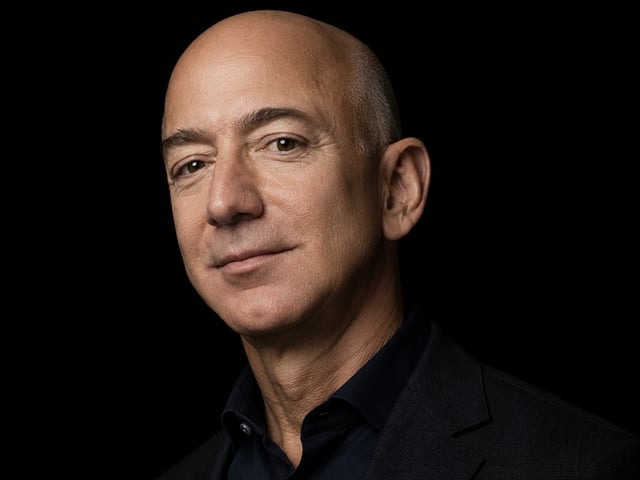
Jeff Bezos — Founder of Amazon and Blue Origin

Entrepreneurs

🇺🇸 Jeff Bezos(b. 1964)

Founder of Amazon and Blue Origin

Jeff Bezos built Amazon from an online bookseller into a global e-commerce and cloud computing behemoth through relentless customer focus.

“Your margin is my opportunity.”

10 Courses · 60 Lessons · 8 Hours

30-day money-back guarantee

The trailer

Jeff Bezos, in 30 seconds.

Watch the Jeff Bezos trailer

Biography

The story of Jeff Bezos, from the beginning.

01

Origins

Born in 1964 to a seventeen-year-old mother, he grew up with his Cuban stepfather Miguel Bezos and spent summers at his grandfather's Texas ranch repairing tractors. He graduated from Princeton with degrees in computer science and electrical engineering and went to Wall Street, becoming the youngest vice president at the quantitative fund D.E. Shaw.

02

The turning point

In 1994, he read that web traffic was growing by 2,300% annually. Applying his “regret minimization framework,” he quit his job, drove to Seattle, and opened an online bookstore in his garage: Amazon sold its first book in July 1995.

03

The rise

He survived the dot-com bubble's burst, with the stock plunging 90%, then transformed Amazon into “the everything store.” He launched Prime in 2005 and AWS in 2006 — the cloud service that now generates most of the profits. Meanwhile, he founded Blue Origin and bought the Washington Post.

04

The method

“Day 1”: always think like it's the first day, make quick decisions on reversible choices, obsess over the customer rather than the competitor, accept low margins, and reinvest everything for years. Meetings begin by silently reading a six-page memo: no slides.

05

Today and the legacy

He stepped down as CEO in 2021 to focus on Blue Origin, climate, and philanthropy. He redefined consumer and business expectations regarding speed, scale, and time horizon.

Tiptico analysis

An operator who industrialised decision-making — writing memos instead of decks, and separating reversible bets from irreversible ones.

Amazon's advantage is usually described as scale or logistics. The more transferable part is the decision architecture Bezos installed: six-page narratives, one-way and two-way doors, working backwards from a press release, and an explicit refusal to let consensus slow a disagreeable bet. Tiptico's analysis works from the shareholder letters, which he wrote annually for twenty-four years and treated as a public commitment device.

  • Customer obsession
  • Long-term thinking
  • Decision frameworks
  • Operational scale
  • Flywheel strategy
  • Innovation and experimentation

One-way doors and two-way doors

Bezos's most portable idea is a classification, not a process. Type 1 decisions are irreversible — sell the company, change the pricing model permanently — and deserve deliberation, dissent and delay. Type 2 decisions are reversible, and treating them with Type 1 seriousness is a form of organisational decay he associated with size. His stated target was to decide with roughly seventy percent of the information you wish you had, because waiting for ninety percent means being slow in most cases that matter.

  • Speed and quality are only in tension for the small share of decisions that cannot be undone.
  • Most organisational sluggishness is misclassification, not caution.
  • 'Disagree and commit' resolves stalemates without pretending consensus was reached.

Working backwards: the press release before the product

Amazon teams write the launch press release and the customer FAQ before building anything. If the release is not compelling in plain language, the product is not worth constructing — and the document, unlike a slide deck, cannot hide vagueness behind bullet points. Bezos banned PowerPoint in leadership meetings for this reason and replaced it with six-page narratives read in silence at the start of the meeting.

The flywheel: why Amazon accepted low margins for decades

The flywheel Bezos described is causal, not motivational: lower prices bring more customers, which brings more third-party sellers, which improves selection, which spreads fixed cost over more units, which permits lower prices again. Once you believe that loop, sacrificing near-term margin is arithmetic rather than courage. It also explains why Amazon's most profitable business, AWS, emerged from internal infrastructure — spare capacity turned into a product because the loop rewarded utilisation.

Day 1 and the specific decay he was guarding against

'Day 2 is stasis, followed by irrelevance, followed by excruciating, painful decline.' Bezos named the symptoms precisely: proxies replacing customers, process becoming the point, slow decision-making, and resistance to external trends. His countermeasures were mechanical — single-threaded owners, small teams, written narratives, customer anecdotes weighted alongside metrics — because he did not trust culture to survive on intention alone.

Failure as a budgeted input

Bezos argued that outsized returns are inherently asymmetric: a failed experiment costs its budget, a successful one can return many multiples, so a company that wants big wins must fund a high absolute number of failures. The Fire Phone's write-down is the example he cited himself, alongside the observation that AWS and Prime came from the same appetite. The uncomfortable implication is that a division with no visible failures is probably under-experimenting.

What you can actually apply from Jeff

  • 01

    Classify every significant decision as reversible or not before debating it.

  • 02

    Write the customer-facing story before committing engineering resources.

  • 03

    Replace slide decks with narratives when the goal is a real decision.

  • 04

    Design a self-reinforcing loop for your business, then feed it even when the margin looks wrong.

  • 05

    Budget for failed experiments explicitly, and measure the rate as well as the outcome.

Independent educational analysis of the ideas, principles and documented work of Jeff Bezos. Tiptico is not affiliated with, endorsed by or authored by Jeff Bezos.

His library

10 courses on how Jeff thinks.

10 Courses · 60 Lessons · 8 Hours. Select a course to see every lesson inside it.

New to Jeff? Start here

Day 1: The Scrappy Origins of Amazon.com

Grasp the foundational principles that launched a retail revolution.

Beginner

Intermediate

Deep Dive

Beginner

Day 1: The Scrappy Origins of Amazon.com

6 lessons

  • 01

    The Garage, the Desk, and the Initial Idea

    8 min read
  • 02

    Identifying the Internet's First 'Killer App'

    8 min read
  • 03

    The Early Culture of Frugality and Discomfort

    8 min read
  • 04

    The Decision to Sell Books First: Strategic Advantage

    8 min read
  • 05

    Raising Capital When No One Understood 'Online'

    8 min read
  • 06

    The Path to IPO: Preparing for Public Scrutiny

    8 min read

Tiptico courses are independent educational analyses based on publicly available information, writings, interviews, speeches and documented decisions. The individuals featured are not instructors, employees, partners, sponsors or endorsers of Tiptico unless explicitly stated.

Join Tiptico

Jeff Bezos and 169+ other Minds.

One membership at $49/month: the entire catalog, new Originals every month, cancel anytime.

  • Access to the entire library
  • New Originals every month
  • Guided learning paths
  • 30-day money-back guarantee
Start Membership — $49/month