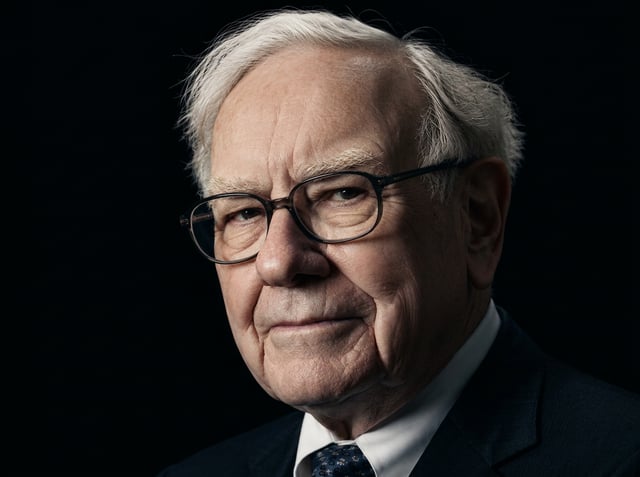
Warren Buffett — Built Berkshire Hathaway into a $900B empire

Finance

🇺🇸 Warren Buffett(b. 1930)

Built Berkshire Hathaway into a $900B empire

Warren Buffett built Berkshire Hathaway into a diversified conglomerate through relentless value investing and compounding, becoming one of history's wealthiest investors.

“Price is what you pay, value is what you get.”

10 Courses · 60 Lessons · 8 Hours

30-day money-back guarantee

The trailer

Warren Buffett, in 30 seconds.

Watch the Warren Buffett trailer

Biography

The story of Warren Buffett, from the beginning.

01

Origins

Born in Omaha in 1930, the son of a stockbroker who later became a congressman, he sold chewing gum and Coca-Cola bottles door-to-door at six years old and bought his first stock (Cities Service) at eleven. By thirteen, he was already filing tax returns, and at fourteen, he used his newspaper delivery savings to purchase 40 acres of farmland, which he leased to a tenant farmer.

02

The turning point

Rejected by Harvard, he discovered that Benjamin Graham was teaching at Columbia—an encounter that changed his life. After earning his master's, he worked unpaid to join Graham-Newman, learned about the margin of safety, and in 1956 returned to Omaha to launch Buffett Partnership with $105,100 raised from family and friends.

03

The rise

In 1965, he took control of Berkshire Hathaway, a declining textile company he later called “the worst deal of my life,” transforming it into an insurance and investment holding company. Using the insurance float from National Indemnity and GEICO, he funded acquisition after acquisition: See's Candies, Coca-Cola, American Express, BNSF, Apple. From 1965, its per-share value grew at a compound annual rate of approximately 20% for over half a century.

04

The method

Charlie Munger's influence shifted him from cheap “cigar butts” to excellent businesses at a reasonable price. He seeks enduring competitive advantages, honest management, predictable cash flow, and then does nothing for decades. His advantage isn't speed but patience: very few, very large decisions, held for a very long time, with liquidity always ready for market panic.

05

Today and the legacy

Even today, he lives in the house he bought in 1958, writes shareholder letters that millions read as a textbook, and has pledged to donate over 99% of his wealth. His legacy isn't a stock certificate; it's the idea that behavior and temperament matter more than intelligence.

Tiptico analysis

How a stock-picker turned an insurance balance sheet into the most patient capital-allocation machine in modern finance.

Most explanations of Warren Buffett stop at 'buy good companies and hold them', which explains almost nothing. The interesting question is structural: how did a Graham-trained bargain hunter end up owning Apple and Coca-Cola, and why did the insurance float behind Berkshire Hathaway matter more than any single stock pick? This is Tiptico's independent reading of the documented record — the letters, the acquisitions, the mistakes he named himself.

  • Value investing
  • Capital allocation
  • Economic moats
  • Insurance float
  • Intrinsic value
  • Temperament and patience

Buffett's investment philosophy, in his own sequence

Buffett's philosophy has three layers stacked in a specific order, and reversing them is where most imitators fail. First comes the circle of competence: refusing to value a business you cannot describe simply. Second comes the business quality test: durable pricing power, honest management, cash that actually reaches the owner. Only third comes price. Graham taught him to start with the discount; Munger persuaded him to start with the business and accept a fair price for an excellent one. The Berkshire letters document that shift almost year by year.

Value investing after Graham: from cigar butts to franchises

Early Buffett bought statistically cheap, structurally dying companies — the 'cigar butt' trade, one last free puff. Berkshire Hathaway itself was one, and he later called it the worst deal of his life. See's Candies broke the habit: a business he paid a premium for, which then produced decades of cash with almost no reinvestment. The lesson he drew was not that cheapness stopped working, but that a compounding franchise makes the price paid matter less every year you hold it.

  • Margin of safety survives the shift — it just moves from the balance sheet to the durability of earnings.
  • A business that needs little capital to grow is worth far more than the same earnings that need heavy reinvestment.
  • Cheapness is a one-time gain; quality is a recurring one.

Capital allocation: the actual job

Buffett describes the CEO's primary job as capital allocation, and Berkshire is built as an allocation engine rather than an operating company. Insurance premiums arrive before claims are paid, creating float — other people's money he can invest in the interim, at a negative cost when underwriting is disciplined. Cash from See's, GEICO and BNSF is not reinvested where it was earned; it is pulled to the centre and redeployed wherever the return is highest. That internal capital market, not stock selection, is the compounding mechanism.

Economic moats and how Buffett tests them

The moat question Buffett asks is deliberately hostile: if a competitor had a billion dollars and the best management available, could they take this business? Coca-Cola survives that test on distribution and mental availability, not on syrup. He watches for pricing power exercised without volume loss, customer switching costs, and cost advantages that widen with scale. Moats that depend on a single brilliant executive he treats as fragile, because they are unpriced bets on succession.

Decision-making: fewer decisions, held longer

Buffett's edge is expressed less in what he buys than in how rarely he acts. He has described a 'punch card' with twenty lifetime slots as a discipline device, keeps large cash reserves precisely so panics become opportunities rather than emergencies, and writes his reasoning down annually in front of shareholders. The behavioural cost of that approach is real: long stretches of underperformance he has to defend publicly. That willingness to look wrong for years is the part almost nobody copies.

What you can actually apply from Warren

  • 01

    Define your circle of competence in writing, then treat everything outside it as unavailable rather than difficult.

  • 02

    Judge a business by the cash it can return to owners, not by the earnings it reports.

  • 03

    Concentrate when conviction and evidence are both high; the cost of over-diversifying is guaranteed mediocrity.

  • 04

    Hold cash as an option on other people's fear, not as a forecast.

  • 05

    Write down the reasoning behind each decision so your future self can audit the thinking, not just the outcome.

Independent educational analysis of the ideas, principles and documented work of Warren Buffett. Tiptico is not affiliated with, endorsed by or authored by Warren Buffett.

His library

10 courses on how Warren thinks.

10 Courses · 60 Lessons · 8 Hours. Select a course to see every lesson inside it.

New to Warren? Start here

The Omaha Oracle's First Principles

Grasp the foundational mental models that define Buffett's investment philosophy.

Beginner

Intermediate

Deep Dive

Beginner

The Omaha Oracle's First Principles

6 lessons

  • 01

    Charlie Munger's Influence: The Latent Genius

    8 min read
  • 02

    Understanding the Business as an Owner, Not a Trader

    8 min read
  • 03

    The Circle of Competence: Knowing What You Don't Know

    8 min read
  • 04

    Mr. Market and the Psychology of Price

    8 min read
  • 05

    Margin of Safety: Protecting Against Unforeseen Errors

    8 min read
  • 06

    The Power of Doing Nothing: Inertia as an Edge

    8 min read

Tiptico courses are independent educational analyses based on publicly available information, writings, interviews, speeches and documented decisions. The individuals featured are not instructors, employees, partners, sponsors or endorsers of Tiptico unless explicitly stated.

Join Tiptico

Warren Buffett and 169+ other Minds.

One membership at $49/month: the entire catalog, new Originals every month, cancel anytime.

  • Access to the entire library
  • New Originals every month
  • Guided learning paths
  • 30-day money-back guarantee
Start Membership — $49/month