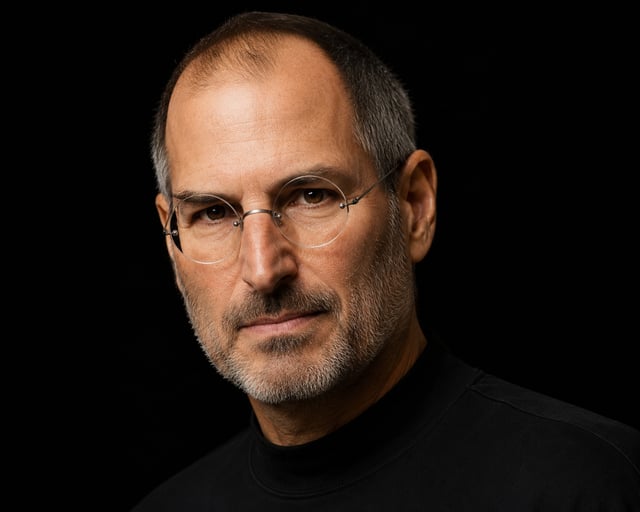
Steve Jobs — Co-founder of Apple, creator of the iPhone

Entrepreneurs

🇺🇸 Steve Jobs(1955–2011)

Co-founder of Apple, creator of the iPhone

Jobs fused art and technology, creating iconic products that redefined industries and shaped modern digital life.

“Stay hungry, stay foolish.”

10 Courses · 60 Lessons · 8 Hours

30-day money-back guarantee

The trailer

Steve Jobs, in 30 seconds.

Watch the Steve Jobs trailer

Biography

The story of Steve Jobs, from the beginning.

01

Origins

Born in San Francisco in 1955 and adopted, he grew up in Mountain View disassembling electronics with his adoptive father. He left Reed College after one semester but continued to audit a calligraphy course that, ten years later, would give the Macintosh its distinctive typography.

02

The turning point

In 1976, in his family's garage, he co-founded Apple with Steve Wozniak. The Apple II created the personal computer market, and in 1980, its IPO made him a millionaire at 25. In 1985, after a conflict with the board, he was ousted from the company he created.

03

The rise

He founded NeXT and, for $5 million, bought Lucasfilm's graphics division, which became Pixar: in 1995, “Toy Story” revolutionized animated cinema. In 1997, Apple, on the brink of bankruptcy, bought NeXT, and he returned: he cut 70% of products and launched the iMac, iPod, iTunes, iPhone, and iPad, making Apple the world's most valuable company.

04

The method

His obsession was the intersection of technology and liberal arts, invisible details, and using “no” as a strategic tool. He didn't conduct market research; he built the products he wanted to use himself, stripping everything down to its essence until only the indispensable remained.

05

Today and the legacy

He died in 2011 at 56. His Stanford commencement speech — “stay hungry, stay foolish” — and the way he integrated design, storytelling, and product remain a benchmark for anyone building something.

Tiptico analysis

A product operator whose real discipline was subtraction — of features, of product lines, and of anyone who could not defend a decision.

The mythology around Steve Jobs is mostly about taste. The documented record is mostly about editing: killing product lines, refusing features, collapsing choices until only the defensible one remained. Tiptico's independent analysis looks at what he actually did between 1997 and 2011 — the product matrix, the integration of hardware and software, the launch craft — and at where that method cost him.

  • Product strategy
  • Design thinking
  • Focus and prioritisation
  • Brand storytelling
  • Vertical integration
  • Creative leadership

Focus as an operating decision, not a slogan

Returning to a near-bankrupt Apple in 1997, Jobs reduced roughly forty products to four, arranged in a two-by-two grid: consumer and pro, desktop and portable. Anything that did not fit a square was cancelled, including profitable lines. The point was resource concentration — the same engineers, freed from maintaining variants, produced the iMac. His framing was that innovation means saying no to a thousand good things, and the grid made that refusal impersonal and defensible.

Why Apple insisted on owning hardware and software together

Jobs's structural bet was that a great experience cannot be assembled from independently optimised parts. Controlling silicon, operating system, industrial design and, eventually, the store let Apple make trade-offs that a licensing model forbids — battery life against thickness, gesture latency against power draw. It also meant carrying costs that competitors outsourced. The iPhone is the argument's clearest proof and the App Store its most contested consequence.

  • Integration buys coherence; it costs flexibility and margin discipline.
  • The user experiences the seams between components, not the components.
  • Owning the interface with the customer is what makes the whole stack defensible.

Design thinking: start at the experience and work backwards

Jobs described the method as beginning with the customer experience and working back to the technology — the opposite of shipping capability and hoping for a use case. In practice that meant prototypes early, decisions made against physical objects rather than specifications, and a willingness to restart late. It also meant a narrow definition of design: not how it looks, but how it works, a distinction he repeated because the industry consistently collapsed it.

Storytelling, launches and the manufactured moment

The Apple keynote was a rehearsed narrative form: an unsatisfactory status quo, a problem stated in the audience's language, then one object presented as the resolution. Jobs sold the benefit before the specification, used comparison sparingly, and left the price to the end. The craft was industrial — weeks of rehearsal, ruthless slide reduction — and it is separable from his personality, which is why it is teachable.

The costs, stated plainly

The same intensity produced documented harm: public humiliation of employees, credit taken from collaborators, the initial denial of paternity, and a 1985 ouster he later called necessary. Analyses that treat the cruelty as a required ingredient of the results are unsupported by the evidence — Apple's most productive stretch came after Tim Cook's operational discipline and Jony Ive's design partnership were in place. Tiptico teaches the method and names the cost rather than romanticising it.

What you can actually apply from Steve

  • 01

    Cut your product or project list until every survivor has a defensible reason to exist.

  • 02

    Start from the experience you want a person to have, then choose technology to serve it.

  • 03

    Own the parts of the stack the customer actually feels; outsource the rest deliberately.

  • 04

    Rehearse important communication as a product, not as a performance of confidence.

  • 05

    Do not confuse intensity with cruelty — the results came from standards, not from humiliation.

Independent educational analysis of the ideas, principles and documented work of Steve Jobs. Tiptico is not affiliated with, endorsed by or authored by Steve Jobs.

His library

10 courses on how Steve thinks.

10 Courses · 60 Lessons · 8 Hours. Select a course to see every lesson inside it.

New to Steve? Start here

The First Byte: Apple's Counterculture Genesis

Understand how Jobs' early ethos set the stage for Apple's disruptive vision.

Beginner

Intermediate

Deep Dive

Beginner

The First Byte: Apple's Counterculture Genesis

6 lessons

  • 01

    Homesteading, Zen, and Calligraphy: Formative Influences

    8 min read
  • 02

    The Garage & The Woz: Building the Apple I

    8 min read
  • 03

    From Hobbyist to Corporation: Raising Capital, Finding Sculley

    8 min read
  • 04

    The Byte that Bit: Apple II's Dominance & IBM's Response

    8 min read
  • 05

    Xerox PARC: The Mouse, GUI, and 'Stealing' the Future

    8 min read
  • 06

    1984: Introducing the Macintosh, Defying Big Blue

    8 min read

Tiptico courses are independent educational analyses based on publicly available information, writings, interviews, speeches and documented decisions. The individuals featured are not instructors, employees, partners, sponsors or endorsers of Tiptico unless explicitly stated.

Join Tiptico

Steve Jobs and 169+ other Minds.

One membership at $49/month: the entire catalog, new Originals every month, cancel anytime.

  • Access to the entire library
  • New Originals every month
  • Guided learning paths
  • 30-day money-back guarantee
Start Membership — $49/month