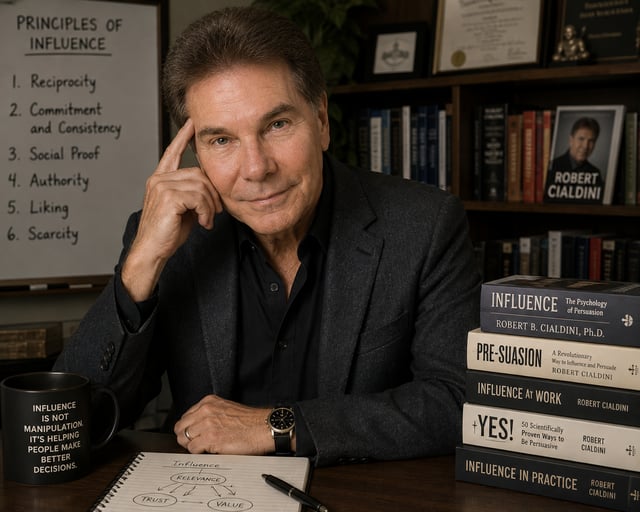
Robert Cialdini — Wrote Influence, defined the 6 principles of persuasion

Psychology & Human Behaviour

🇺🇸 Robert Cialdini(b. 1945)

Wrote Influence, defined the 6 principles of persuasion

Robert Cialdini turned decades of field research into the definitive framework of ethical influence.

“People prefer to say yes to those they know and like.”

6 Courses · 30 Lessons · 4 Hours

30-day money-back guarantee

Biography

The story of Robert Cialdini, from the beginning.

01

Origins

Robert Cialdini (1945-04-27–present) did not arrive at the top of psychology & human behaviour through privilege or a shortcut. The early years were unglamorous: long stretches of obscurity, work nobody applauded, and an obsession with a single question that most people around them considered a strange thing to care about. What separated them from equally talented peers was not raw ability but the decision, taken very early, to go deeper than anyone else was willing to go on six principles — and to keep going long after the initial excitement wore off.

02

The turning point

Robert Cialdini turned decades of field research into the definitive framework of ethical influence. That is the moment the trajectory changes. Until then they were a promising name; afterwards they became the reference point. The insight itself was simple enough to explain in a sentence, which is exactly why it was so easy for everyone else to dismiss it. They did not dismiss it: they bet their time, their reputation and often their money on it, and then defended it publicly while it was still unproven. Wrote Influence, defined the 6 principles of persuasion

03

The rise

What followed was a body of work built over years, not months, concentrated on six principles, reciprocity, social proof. Each phase came with public setbacks — a failed project, a period of stagnation, a decision the market or the press punished before it was proved right. They kept the same standard through all of it. The record people admire today is not a single lucky breakthrough but the compounding of hundreds of unglamorous decisions made in the same direction, repeated while competitors rotated to whatever felt easier that year.

04

The method

Their approach — Influence & Persuasion Science — reduces to a handful of rules applied with unusual discipline: absurdly high standards on quality, honest measurement of results, the willingness to kill what is not working early, and the courage to double the commitment to what is. In practice this means working relentlessly across six principles, reciprocity, social proof, commitment and consistency, ethical persuasion, turning abstract principles into daily routines. They optimise for the decisions that matter most and deliberately ignore almost everything else, which is why their output looks simple from the outside and is nearly impossible to copy from the inside.

05

Setbacks and the cost

No serious career is linear, and theirs was not either. There were years of doubt, rivals who moved faster, criticism from people whose opinion mattered to them, and at least one moment where quitting would have been the reasonable choice. The interesting part is not that they suffered these things but how they processed them: as information rather than as verdicts. Mistakes were dissected in public, assumptions were rewritten, and the method that made them famous is largely a list of scars turned into rules.

06

What you actually learn from them

Studying Robert Cialdini is not about imitating a personality; it is about extracting transferable judgement. How they decided what to work on, how they evaluated risk, how they handled being wrong, how they built the people and systems around them, and how they protected the long horizon against short-term pressure. Those judgements travel across industries — that is why their frameworks still hold up decades after the specific context that produced them disappeared.

07

Today and the legacy

Their influence now exceeds their own results: the approach is studied, imitated and taught, and entire careers have been built on ideas they made ordinary. At Tiptico we have gone through their decisions, interviews, letters and failures and rebuilt them as step-by-step frameworks you can apply to your own work — the reasoning, not just the highlights.

Tiptico analysis

The researcher who went undercover in sales training programmes to document exactly how compliance is engineered.

Cialdini's method was empirical and slightly odd: he spent three years training as a car salesman, fundraiser and advertiser to catalogue what practitioners had discovered by trial and error, then tested it experimentally. The result is seven principles of influence with a clear ethical line — he calls the misuse of them 'smuggling' and treats it as both wrong and commercially self-destructive.

  • Persuasion and influence
  • Social proof
  • Reciprocity
  • Commitment and consistency
  • Ethical persuasion
  • Pre-suasion

The seven principles, and what each actually requires

Reciprocity works when the gift is unexpected, personalised and genuinely first. Commitment and consistency bind hardest when the initial step is active, public and freely chosen. Social proof is strongest from people similar to the audience and in conditions of uncertainty. Authority requires demonstrated expertise, signalled credibly. Liking follows similarity and sincere praise. Scarcity motivates through anticipated loss rather than gain. Unity — the seventh, added later — comes from shared identity rather than mere similarity: not people like us, but people who are us.

  • Each principle has enabling conditions; applied without them, it fails or backfires.
  • Unity outperforms liking because identity is stronger than affinity.
  • Scarcity claims must be true, or the effect inverts once discovered.

Pre-suasion: the moment before the message

Cialdini's later work argues that what you direct attention to immediately beforehand changes how the message lands, because whatever is momentarily salient is treated as important and causal. Asking someone whether they consider themselves adventurous before making an offer changes acceptance rates. The practical claim is that the framing moment is a designable part of the communication, not preamble.

The ethical boundary he drew explicitly

Cialdini distinguishes detecting a genuine strength and communicating it — legitimate — from manufacturing the appearance of one. His research on organisational culture found that firms tolerating dishonest persuasion suffer higher employee turnover and fraud, because staff who watch customers being deceived stop trusting the employer. The ethical argument and the commercial argument point the same way.

Where the effects are smaller than the popular version claims

Some influence findings have weakened under replication scrutiny, and effect sizes in field settings are typically modest rather than transformative. The reliable use of this material is as a checklist for removing friction and communicating true strengths, not as a set of levers that reliably override judgment.

What you can actually apply from Robert

  • 01

    Give first, unexpectedly and specifically, before you ask.

  • 02

    Secure a small, active, voluntary commitment rather than arguing for the large one.

  • 03

    Show evidence from people the audience recognises as similar to themselves.

  • 04

    Use identity, not just likeability — shared 'we' beats shared interests.

  • 05

    Only surface strengths that genuinely exist; manufactured influence corrodes the organisation using it.

Independent educational analysis of the ideas, principles and documented work of Robert Cialdini. Tiptico is not affiliated with, endorsed by or authored by Robert Cialdini.

His library

6 courses on how Robert thinks.

6 Courses · 30 Lessons · 4 Hours. Select a course to see every lesson inside it.

New to Robert? Start here

Six principles: The Robert Cialdini Playbook

See how Robert Cialdini turns six principles into a repeatable advantage.

Beginner

Intermediate

Deep Dive

Beginner

Six principles: The Robert Cialdini Playbook

5 lessons

  • 01

    Robert Cialdini on why six principles decides everything

    8 min read
  • 02

    Inside six principles: the first move Robert Cialdini makes

    8 min read
  • 03

    Robert Cialdini breaks down reciprocity step by step

    8 min read
  • 04

    The mistakes Robert Cialdini sees people make with reciprocity

    8 min read
  • 05

    Robert Cialdini shows you how to run this yourself

    8 min read

Tiptico courses are independent educational analyses based on publicly available information, writings, interviews, speeches and documented decisions. The individuals featured are not instructors, employees, partners, sponsors or endorsers of Tiptico unless explicitly stated.

Join Tiptico

Robert Cialdini and 169+ other Minds.

One membership at $49/month: the entire catalog, new Originals every month, cancel anytime.

  • Access to the entire library
  • New Originals every month
  • Guided learning paths
  • 30-day money-back guarantee
Start Membership — $49/month